ESSENTIAL GUIDANCE · COMPARISON · 9 min read
Part of Foundation insights →Cyber Essentials vs Cyber Essentials Plus Explained
Technical review lead: James Hinton · Offensive security lead
Cyber Essentials and Cyber Essentials Plus are UK security certifications designed to help organisations reduce common cyber risks and prove that essential controls are in place. Both are built around the same five technical control areas, but they differ in how those controls are checked, how much assurance they provide, and how much preparation they usually require. If you are comparing cyber essentials vs cyber essentials plus, the practical question is not simply “which is better?” but “what level of proof do our customers, contracts and risk profile require?”
What is the difference between Cyber Essentials and Cyber Essentials Plus?
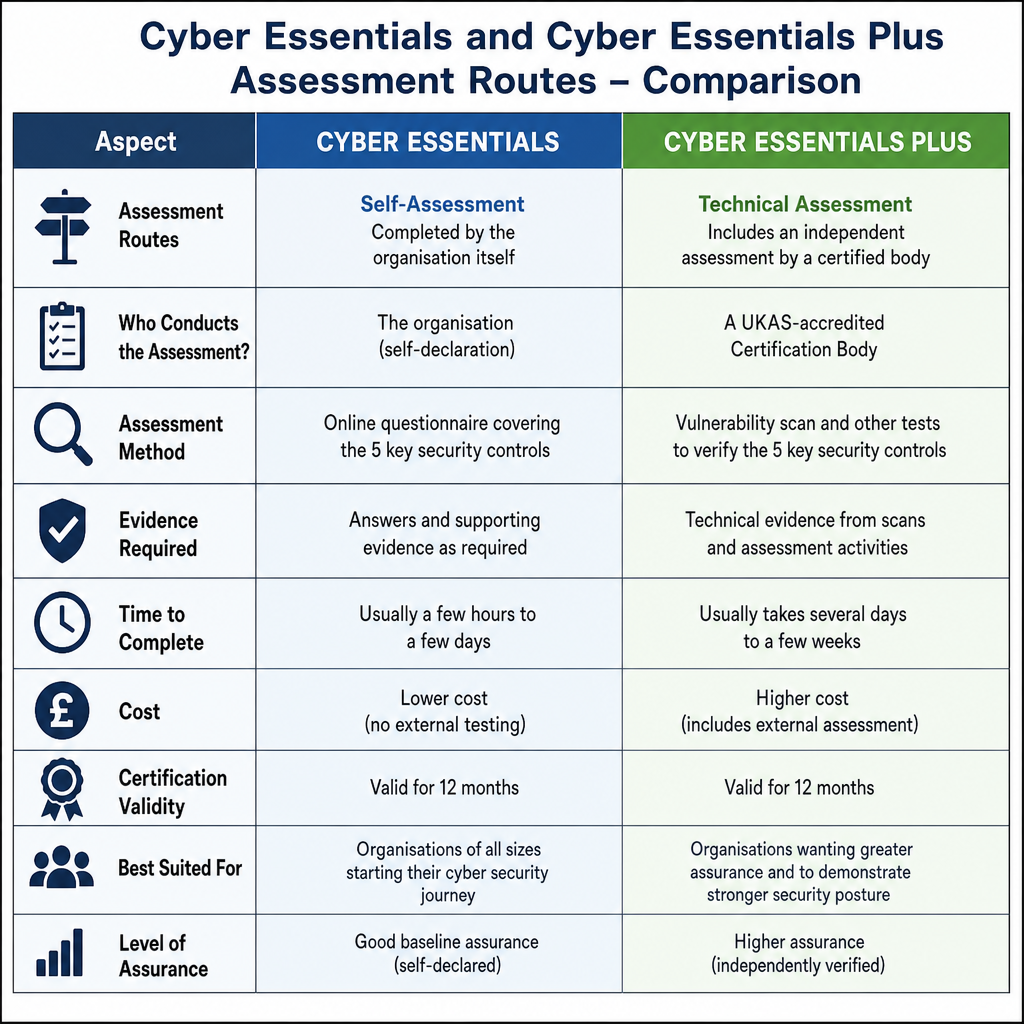
The difference between cyber essentials and cyber essentials plus is that Cyber Essentials is a verified self-assessment, while Cyber Essentials Plus includes independent technical testing of your systems. Cyber Essentials asks your organisation to answer a questionnaire about how it meets the scheme’s requirements; an assessor reviews those answers. Cyber Essentials Plus goes further by testing whether the same controls are working in practice, which gives customers and procurement teams a higher level of assurance. The NCSC describes both levels as covering the same five technical controls, with Plus adding more rigorous independent technical testing; basic Cyber Essentials starts from £320 + VAT, while Plus pricing is quoted according to the size and complexity of the network. (ncsc.gov.uk)
For many SMEs, Cyber Essentials is a strong first step in business cybersecurity. It gives structure to everyday security tasks such as patching laptops, controlling administrator accounts and protecting cloud services. Cyber Essentials Plus is usually chosen when a contract asks for it, when a business wants stronger evidence for customers, or when leadership wants independent confirmation that controls are more than written policy.
The five controls behind both certifications
Both cyber essentials and cyber essentials plus are based on five technical control areas. These controls are intentionally practical: they focus on common weaknesses that attackers regularly exploit, rather than trying to cover every possible cyber scenario.
- Firewalls: Firewalls help prevent unauthorised access between your devices, networks and the internet. In practice, this means removing unnecessary inbound access, changing default passwords and making sure routers or cloud firewall rules are configured deliberately rather than left open.
- Secure configuration: Devices and services should be set up to reduce avoidable risk. That includes disabling unused accounts, removing unnecessary software, changing default settings and ensuring users do not have more privileges than they need.
- Security update management: Supported operating systems, applications, firmware and services need timely updates. This is one of the most visible cybersecurity requirements, because unsupported or unpatched software can create straightforward entry points for attackers.
- User access control: Staff should only have access to the systems and data needed for their role. Administrator accounts should be limited, separated from normal day-to-day accounts where appropriate, and reviewed when people move roles or leave.
- Malware protection: Organisations must reduce the risk from malicious software through suitable controls. Depending on the environment, this may involve anti-malware tools, application allow-listing, controlled app stores or other approved protective approaches.
The value of these controls is their combined effect. A weak password is less damaging if MFA is enabled. A phishing email is less likely to lead to full compromise if users do not have administrator rights. An exposed service is easier to defend when firewall rules, patching and configuration are managed together.
How have the 2026 Cyber Essentials changes affected certification?
The 2026 requirements have made cloud services, MFA and patching discipline even harder to ignore. From 27 April 2026, applicants must enable MFA on all cloud service accounts where it is available; IASME says this change affects how applicants are assessed and is intended to reflect the importance of protecting cloud services. (iasme.atlassian.net)
The NCSC’s Cyber Essentials Requirements for IT Infrastructure v3.3 also clarifies the scheme’s treatment of organisational services and cloud services, including services accessed by account and used to store or process organisational data. (ncsc.gov.uk) For businesses, the message is simple: do not assume a SaaS platform sits outside your scope just because it is hosted elsewhere. If your people use it for work data or work services, it is likely to need attention during preparation.
Security update management is another area where organisations should be strict. If you rely on manual updates, you need a reliable process for identifying, approving and applying high-risk or critical fixes quickly. A spreadsheet that is rarely updated will not be enough. The safer approach is to keep an accurate asset list, enable automatic updates where suitable, monitor exceptions and check that remote devices are actually receiving patches.
Cyber Essentials is often enough for a first assurance step
Cyber Essentials suits organisations that need a recognised baseline for cybersecurity standards, supplier questionnaires or lower-risk contracts. It is also useful when a business has never formally documented its security controls before. The questionnaire forces useful conversations: which devices are in scope, who has admin rights, which cloud services are used, and whether unsupported software is still present.
It can also support public sector procurement. UK government guidance states that since 2014, suppliers bidding for certain public contracts have needed Cyber Essentials or Cyber Essentials Plus certification, or equivalent controls, where the contract has relevant cyber risk characteristics. (gov.uk)
Choose Cyber Essentials when:
- A tender or customer asks for baseline certification.
- You want an affordable, structured starting point for business cybersecurity.
- Your IT environment is relatively simple and centrally managed.
- You need to demonstrate progress before investing in deeper assurance.
- You are preparing for Cyber Essentials Plus but need to establish the basics first.
Cyber Essentials Plus provides stronger evidence
Cyber essentials plus is more demanding because an external assessor tests sampled systems instead of relying only on written answers. IASME explains that the Plus audit must be completed within three months of the most recent Cyber Essentials certification, and that the pass bar is higher: if non-compliance is found during Plus, the applicant has 30 days to remediate but cannot pass until it is fixed. (ce-knowledge-hub.iasme.co.uk)
That makes Plus valuable when assurance matters commercially. If you sell to larger enterprises, regulated sectors, defence supply chains or security-conscious customers, independent testing may carry more weight than self-assessment alone. It also gives your internal team a clearer view of whether everyday controls are genuinely embedded.
However, Plus should not be treated as a quick add-on. The audit may expose issues that were hidden during the questionnaire stage, such as a forgotten laptop, outdated browser extension, weak local administrator practice or a cloud account without MFA. The best time to prepare is before booking the test, not after the assessor finds the gaps.
Cyber Essentials and Plus at a glance
| Decision | Cyber Essentials | Cyber Essentials Plus |
|---|---|---|
| How controls are checked | Verified self-assessment, reviewed by an assessor. | Independent technical testing of the same five control areas, in addition to Cyber Essentials. |
| What the result demonstrates | Assessed answers about the controls within the agreed scope. | Additional evidence that assessed controls work in practice on sampled systems. |
| Preparation | Confirm scope, meet the requirements and provide accurate answers. | Prepare for technical checks as well as completing Cyber Essentials. |
| Cost basis | Certification fee plus any preparation, remediation and support costs. | Obtain a scoped assessment quotation and confirm what preparation and repeat checks include. |
| Which route fits? | Where the required assurance is satisfied by Cyber Essentials. | Where a contract requires Plus or independent technical verification is needed. |
Neither route replaces a separately scoped penetration test. Confirm the certification level and scope required by your customer or tender before purchasing.
Get a Free copy of a Cyber Essentials checklist
Need help with Cyber Essentials? Contact us for help →
Practical preparation that reduces the risk of failure
The most successful certification projects start with scope. List every device, user, cloud service and location that can access organisational data or services, including remote working devices and bring-your-own-device arrangements where they are allowed. Then decide whether anything can be removed from scope by changing how it accesses data, replacing unsupported software, or tightening access routes.
Use this preparation checklist before submission or audit:
- Map assets clearly: Include laptops, desktops, servers, mobiles, tablets, network equipment, cloud platforms and key SaaS tools.
- Check MFA everywhere it is available: Prioritise email, identity platforms, file sharing, finance systems, CRM, admin portals and any service holding customer or business data.
- Review administrator accounts: Remove unused admin rights, separate admin and standard accounts where appropriate, and document who can approve privileged access.
- Patch before you answer: Do not rely on policy wording alone. Check actual device status, including remote machines that may not connect often.
- Remove unsupported software: If it is no longer receiving vendor security updates, upgrade it, replace it or isolate it from the assessed environment.
- Test malware protection: Confirm that protective tools are active, updated and reporting correctly, rather than merely installed.
- Keep evidence simple: Screenshots, exports, asset lists and policy notes should be clear enough for an assessor to understand without lengthy explanation.
The biggest pitfalls are rarely exotic. They are usually incomplete asset discovery, inconsistent patching, weak authentication policies, over-permissive users and confusion about cloud scope. Fix those early and both certification levels become much more predictable.
Choosing the right route
If you need a recognised baseline and want to improve security without overwhelming the business, Cyber Essentials is the natural starting point. If customers, tenders or internal risk appetite require stronger proof, Cyber Essentials Plus is the better fit. Many organisations take a staged route: complete Cyber Essentials, use the findings to tighten controls, then move to Plus once patching, MFA and access management are stable.
The key is to treat certification as more than a badge. Used well, these security certifications create a repeatable rhythm for reviewing devices, accounts, updates and cloud services every year. That rhythm is where the real security benefit sits: fewer unknowns, fewer avoidable weaknesses, and clearer evidence that your organisation takes cyber risk seriously.
Q&A
Common questions
What are the main differences between Cyber Essentials and Cyber Essentials Plus?
Both cover the same five technical control areas. Cyber Essentials uses verified self-assessment; Plus adds independent technical testing. Choose the route that meets the assurance and scope your customer or contract requires.
Does Cyber Essentials Plus replace a penetration test?
No. The Plus assessment verifies scheme controls. A penetration test answers separately agreed security questions about defined systems, attack paths or business logic. Confirm which evidence you need rather than treating the two activities as interchangeable.
How should we budget for either route?
Separate the certification or assessment fee from internal preparation, remediation and optional support. For Plus, request a quotation based on your environment and confirm the treatment of repeat checks.